Home and Community Based Services
Happy Home and all sponsored residential homes are HCBS compliant. Home and Community-Based Services (HCBS) began in 1981 with the creation of the Medicaid 1915(c) waiver, allowing states to provide long-term services and supports outside of institutional settings. HCBS is designed to help individuals with disabilities, chronic health conditions, or support needs live in their own homes and communities rather than in hospitals, nursing facilities, or other institutions. The purpose of HCBS is to promote independence, dignity, choice, and inclusion by offering person-centered supports that reflect individual preferences, strengths, and goals. At its core, HCBS exists to ensure people can receive the care they need while remaining connected to family, community, and everyday life in the least restrictive setting possible.
How Sponsored Homes follow HCBS
Home and Community-Based Services (HCBS) directly shape how Sponsored Residential homes operate by ensuring individuals receive support in real homes—not institutional settings—while maintaining choice, dignity, and community connection. Because Sponsored Residential is an HCBS service, the home must function as a private residence, not a facility and maintain assured rights. Individuals have meaningful control over their daily lives, including routines, visitors, meals, schedules, and personal space.
HCBS requires that services be person-centered, meaning support is based on the individual’s preferences, strengths, and goals rather than a program-driven model. In Sponsored Residential homes, this means the sponsor’s household routines adapt to the individual—not the other way around.
HCBS also emphasizes integration into the broader community. Individuals living in Sponsored Residential homes are supported to participate in community activities, build relationships, and access services in typical community settings to the greatest extent possible.
Finally, HCBS standards protect rights, privacy, and autonomy. Any limits on rights must be justified, individualized, and formally documented. For Sponsored Residential homes, this reinforces the balance between providing necessary support and preserving the freedom, comfort, and dignity that come from living in a family home.
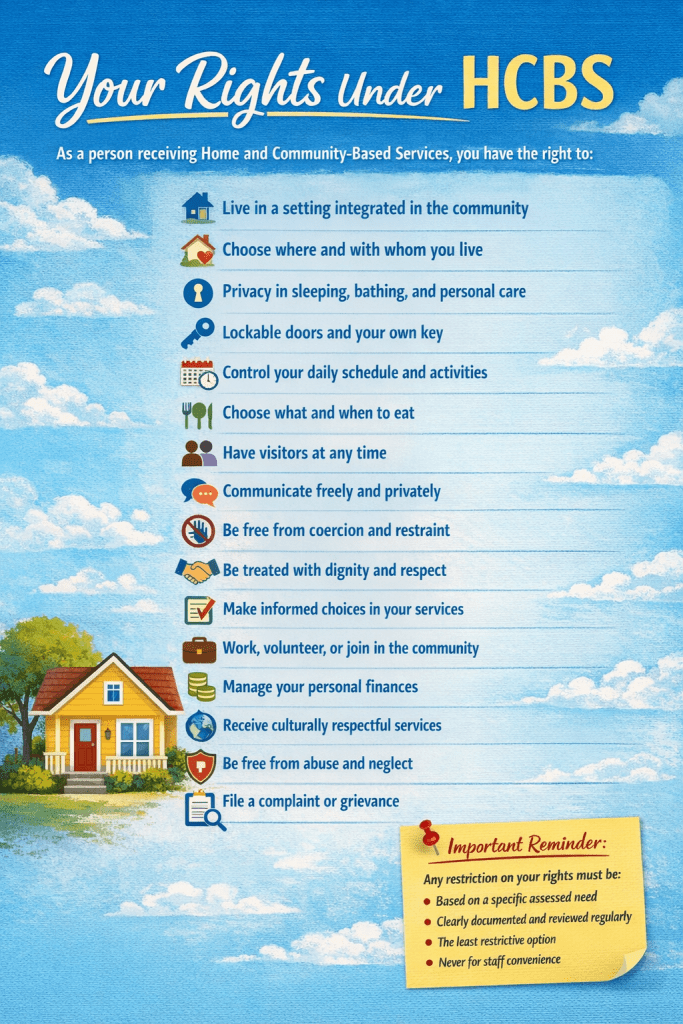
HCBS Defined Assured Rights
🌿 1. Community Integration
Individuals have the right to:
- Live and receive services in the community
- Participate in community activities of their choice
- Access the same community opportunities as people without disabilities
Services cannot isolate or segregate someone from broader community life.
🏠 2. Choice of Setting
Individuals have the right to:
- Choose where they live
- Choose their service providers
- Change providers if desired
No one should be forced into a particular setting.
🔐 3. Privacy
Individuals have the right to:
- A legally enforceable lease or residency agreement
- Privacy in their bedroom and personal space
- Lockable doors (with access for staff as needed for safety)
- Private communications (mail, phone, visitors)
👥 4. Dignity and Respect
Individuals must be treated with:
- Respect and courtesy
- Freedom from coercion
- Freedom from restraint (unless properly authorized and documented)
- Protection from abuse, neglect, and exploitation
🗓 5. Autonomy and Independence
Individuals have the right to:
- Make choices about daily routines
- Decide what and when to eat
- Choose visitors
- Control personal resources
Services must be person-centered — not provider-centered.
🛡 6. Freedom from Unnecessary Restrictions
Any restriction on a person’s rights (for example, locked cabinets, supervision limits, behavior plans) must:
- Be individually assessed
- Be clinically justified
- Be documented in the Individual Support Plan
- Be time-limited and reviewed regularly
Restrictions cannot be “house rules” applied to everyone.
💬 7. Person-Centered Planning
Individuals have the right to:
- Participate in their own service planning
- Have goals that reflect their preferences
- Invite who they want to their planning meetings
❤️ Why This Matters in Sponsored Residential
In a sponsored residential setting — especially when parents are sponsors — HCBS rights ensure that:
- The home remains the individual’s home, not the provider’s program
- The adult child’s autonomy continues to grow
- Support balances safety with independence
- Families honor dignity while still providing needed supervision
HCBS is about protecting choice, voice, and inclusion — even within the most loving homes.
Postings in Each Home
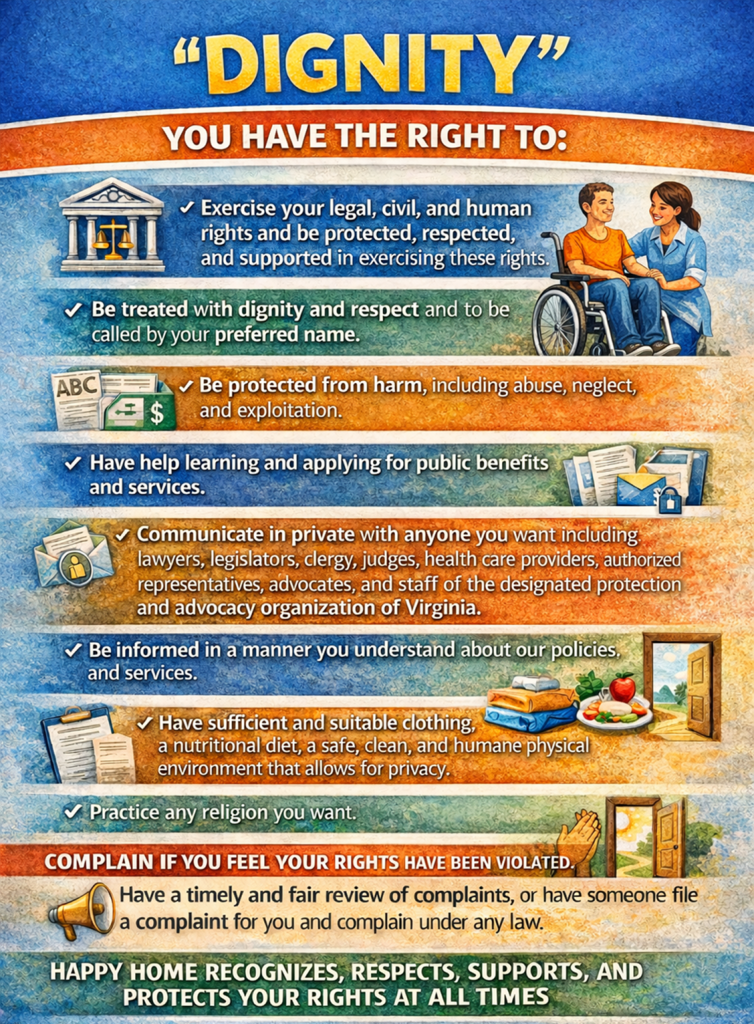
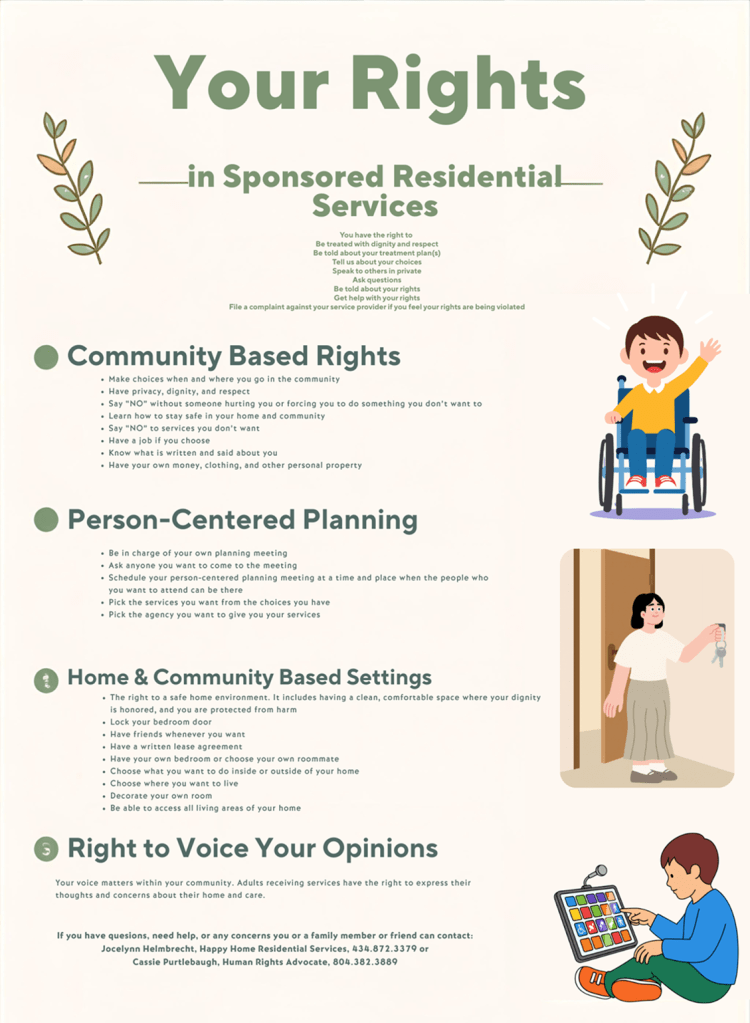
Mandatory posters are required in each Sponsored Residential home to protect rights, safety, and access to help. Because Sponsored Residential services fall under Home and Community-Based Services (HCBS) and are overseen by Virginia Department of Behavioral Health and Developmental Services, individuals must always have clear, visible information about their rights and how to get support or report concerns.
Purpose of Mandatory Posters
1. Protect Individual Rights
Posters ensure individuals know they have the right to dignity, privacy, choice, and freedom from abuse, neglect, or exploitation. These rights apply even though the setting is a private home.
2. Ensure Access to Help
Posters list contact information for advocacy and reporting, so individuals, families, and visitors know who to call if there is a concern—without having to ask staff or sponsors.
3. Promote Transparency
Posting required information openly reinforces that Sponsored Residential services are accountable, regulated, and centered on the individual—not hidden or informal.
4. Support Safety and Emergency Preparedness
Some posters provide guidance for emergencies or reporting urgent issues, helping ensure quick access to assistance when needed.
Training
Sponsors must complete training that ensures individuals are supported in ways that protect choice, dignity, autonomy, and community inclusion while living in a family home. HCBS training is designed to make sure the home remains a true private residence, not an institutional setting.
Happy Home and all sponsored homes are trained and understand the importance of protecting, honoring, and preserving the rights of our residents. If an individual, family, or friend believes a resident’s human rights have been offered, restricted improperly, or violated—including concerns related to dignity, privacy, choice, safety, or freedom from abuse, neglect, or exploitation—they have the right to report the concern without fear of retaliation.
Concerns may be reported verbally or in writing to
- Happy Home Executive Director, Jocelynn Easton
- The Human Rights Advocate for our areais Cassie Purtlebaugh 877-600-7437. Her email is cassie.purtlbaugh@dbhds.virginia.gov
- The disAbility Law Center: 800-552-3962.
Reports should be made as soon as possible, but may be made at any time. All reports are taken seriously, documented, reviewed promptly, and addressed through established human rights and grievance processes, with protections in place to ensure confidentiality and continued access to services.
More information can be found on the HCBS website
Required posters for the disAbility Law Center are found here. Need help? and You have the Right
 Happy Home Sponsored Residential Services